
Colour code
An access discriminator similar in purpose to analogue CTCSS. VKDMR repeaters and hotspots use Colour Code 1.
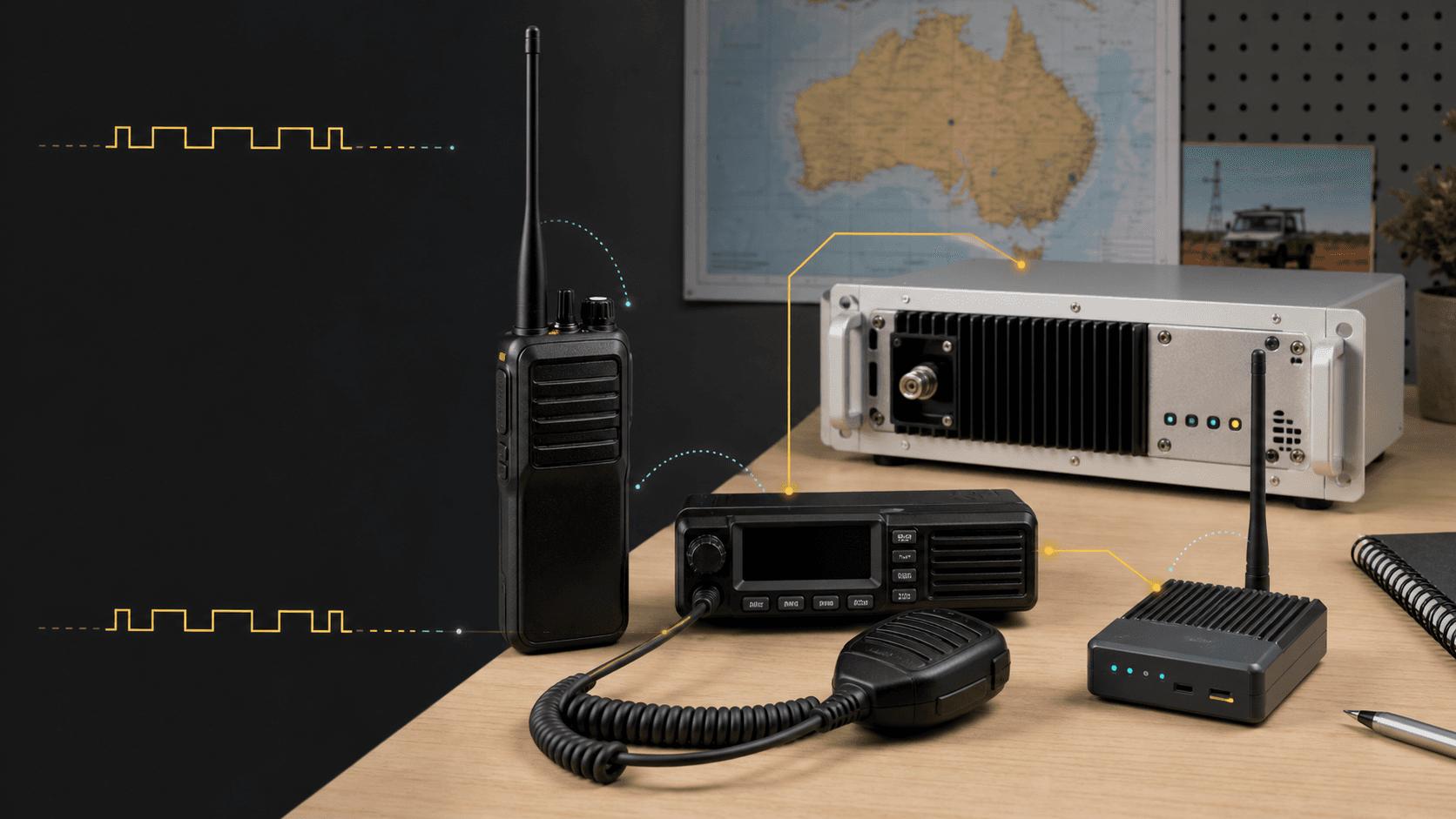
A practical technical guide
DMR combines an RF channel, two timeslots, digital identities, and network routing. Learn the pieces in the order your radio uses them, then see how RadNET connects into the VKDMR IPSC3 network.
01 The signal
DMR Tier II uses two-slot TDMA on a 12.5 kHz carrier. A repeater alternates between Slot 1 and Slot 2 in 30 millisecond bursts, allowing two conversations or data paths to share the channel.
An access discriminator similar in purpose to analogue CTCSS. VKDMR repeaters and hotspots use Colour Code 1.
The physical TDMA path: Slot 1 or Slot 2. It is capacity, not the destination of the call.
A group address carried inside the digital call. It tells the network which audience should receive the audio.
Your unique digital identity. It is transmitted with each call and lets radios and dashboards resolve your callsign.
02 The RadNET decision
DMR gave RadNET a practical combination of spectrum efficiency, obtainable hardware, a published multi-vendor air interface, and immediate access to an established Australian amateur network. It was a system ARNSW could deploy, maintain, and continue improving with the amateur community.
Two 30 ms timeslots allow a Tier II repeater to support two independent paths without requiring a second RF channel pair.
The large commercial DMR market created a steady flow of reasonably priced new and used radios, repeaters, accessories, and service knowledge.
Compatible models can run amateur-developed firmware such as OpenGD77, adding operating workflows designed around amateur use rather than fleet dispatch.
Explore OpenGD77DMR's air interface is defined in the ETSI TS 102 361 series. That gives RadNET an interoperable standard instead of a single-vendor RF system.
VKDMR's locally developed IPSC3 platform can evolve routing, roaming, hotspot behaviour, and diagnostics around real amateur-network operation.
VKDMR already connected repeaters, hotspots, clubs, and operators across Australia, giving RadNET an established community and national reach.
About the VKDMR network03 Choosing hardware
For repeater operation, confirm DMR Tier II support, the correct amateur band, suitable Customer Programming Software (CPS), and an obtainable cable. Displays and feature lists matter less than a clean RF path and a codeplug you can maintain.
The everyday choice for local repeater access, events, field work, and travel.
A stronger RF platform for regular driving, fixed stations, and fringe coverage areas.
Rugged hardware with disciplined channel operation and often excellent RF and audio performance.
A low-power RF access point for locations without usable repeater coverage.
04 Programming model
The codeplug is the radio's operating database. Build it from identity to destination to RF channel, then organise those channels into zones you can navigate under real operating conditions.
Minimum channel record
Save a known-good backup before changing firmware, contacts, zones, or channel definitions.
05 VKDMR IPSC3
Your radio reaches a repeater or hotspot over RF. IPSC3 then uses endpoint state, timeslot, talkgroup, and radio identity to route the call across the VKDMR network. The dashboard makes that path visible.
The network's static VK calling and general-operation path. Use specialist groups when that audience is intended.
Records and returns your audio so you can check level, clarity, timing, and whether your ID resolves correctly.
On supported IPSC3 endpoints, scan mode follows active traffic and can route a reply to the last active group.
IPSC3 can route a direct call toward the endpoint where the destination radio was recently seen.
IPSC3 controls competing traffic while a dynamic group is active to avoid unexpected drag-back.
Closer to repeater slot behaviour, provided the hotspot and radio are programmed consistently.
06 Good operating
Digital routing is fast, but not instantaneous. A deliberate operating rhythm gives repeaters, hotspots, announcements, and remote paths time to establish and release cleanly.
07 First contact
Work through one known repeater before adding a state-wide codeplug. When the basic path works, expand in small, testable steps.
Register a DMR ID and program your own ID into the radio before transmitting.
Start with the frequencies and operating details for a single nearby RadNET repeater.
Add only the contacts, channels, and zones you understand. Keep the first version simple.
Confirm RX/TX frequency, colour code, timeslot, talkgroup, admit criteria, and power.
Key briefly and verify that IPSC3 sees the expected radio ID, endpoint, slot, and talkgroup.
Use Parrot on TG 9990 where available, then adjust microphone gain and operating technique.